Human life has changed dramatically over the centuries.
We communicate across continents in seconds, access extraordinary amounts of information, and live within technological and social systems that previous generations could hardly have imagined.
Our daily routines, professional responsibilities, and ways of relating to the world have been transformed.
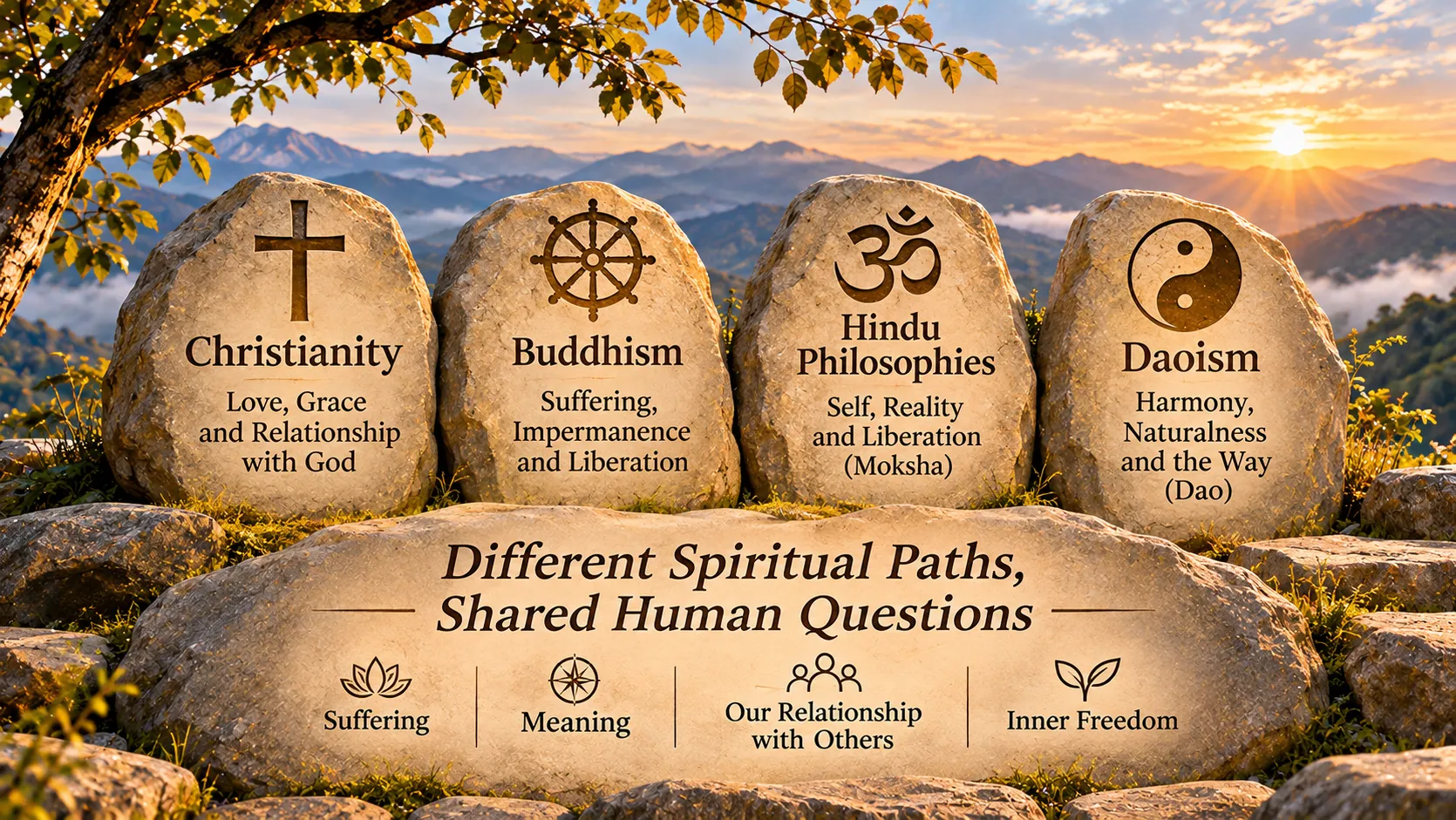
Yet some of the questions that accompany human existence remain remarkably familiar.
How should we respond to circumstances beyond our control?
Why do we continue wanting more, even when many of our needs have been met?
How can we live meaningfully in a world shaped by uncertainty?
What does it mean to act wisely, treat others well, and understand ourselves?
Long before modern psychology, digital technology, and contemporary discussions of personal development, people were exploring these questions through philosophy, contemplation, ethical inquiry, and spiritual practice.
Their answers were not identical.
They emerged from different cultures, historical circumstances, and understandings of reality.
But many ancient traditions developed sophisticated ways of examining the relationship between human experience, attention, desire, conduct, and the search for a meaningful life.
Engaging with these traditions today does not require believing that the past possessed every answer.
It invites us to consider whether some questions become clearer when examined through perspectives different from our own.
Why Ancient Questions Still Matter
Modern life provides extraordinary tools for solving practical problems.
We can organize complex projects, communicate instantly, access educational resources, and use scientific knowledge to improve many aspects of human existence.
But technological advancement does not automatically resolve every difficulty associated with being human.
We may have access to more information while struggling to direct our attention.
We may enjoy greater material possibilities while remaining uncertain about what constitutes enough.
We may become more efficient in our work without necessarily feeling that our efforts contribute to a meaningful life.
These tensions are not evidence that modernity has failed.
They reflect the fact that technical progress and human wisdom address overlapping but different questions.
Technology can help us accomplish tasks.
Philosophical and contemplative inquiry can help us examine why we pursue those tasks, how we relate to their outcomes, and what we consider worth accomplishing.
Ancient wisdom becomes relevant not because older ideas are automatically superior, but because certain human concerns persist across changing circumstances.
A person facing professional uncertainty today may find value in examining questions about responsibility and control.
Someone experiencing dissatisfaction despite material comfort may benefit from investigating the relationship between desire and contentment.
A person overwhelmed by constant stimulation may become interested in traditions that developed practices of attention and contemplation.
The value lies not in importing ancient answers without question, but in allowing established traditions of thought to deepen our own inquiry.
Stoicism and the Responsibility of Choosing Well
Among the philosophical traditions of the ancient Mediterranean world, Stoicism offers a particularly useful perspective on responsibility, judgment, and human conduct.
Developed in ancient Greece and later influential in Rome, Stoicism examined how human beings might live well within a world they cannot completely control.
Stoic thinkers such as Epictetus, Seneca, and Marcus Aurelius approached these questions from different personal circumstances, but shared important philosophical commitments.
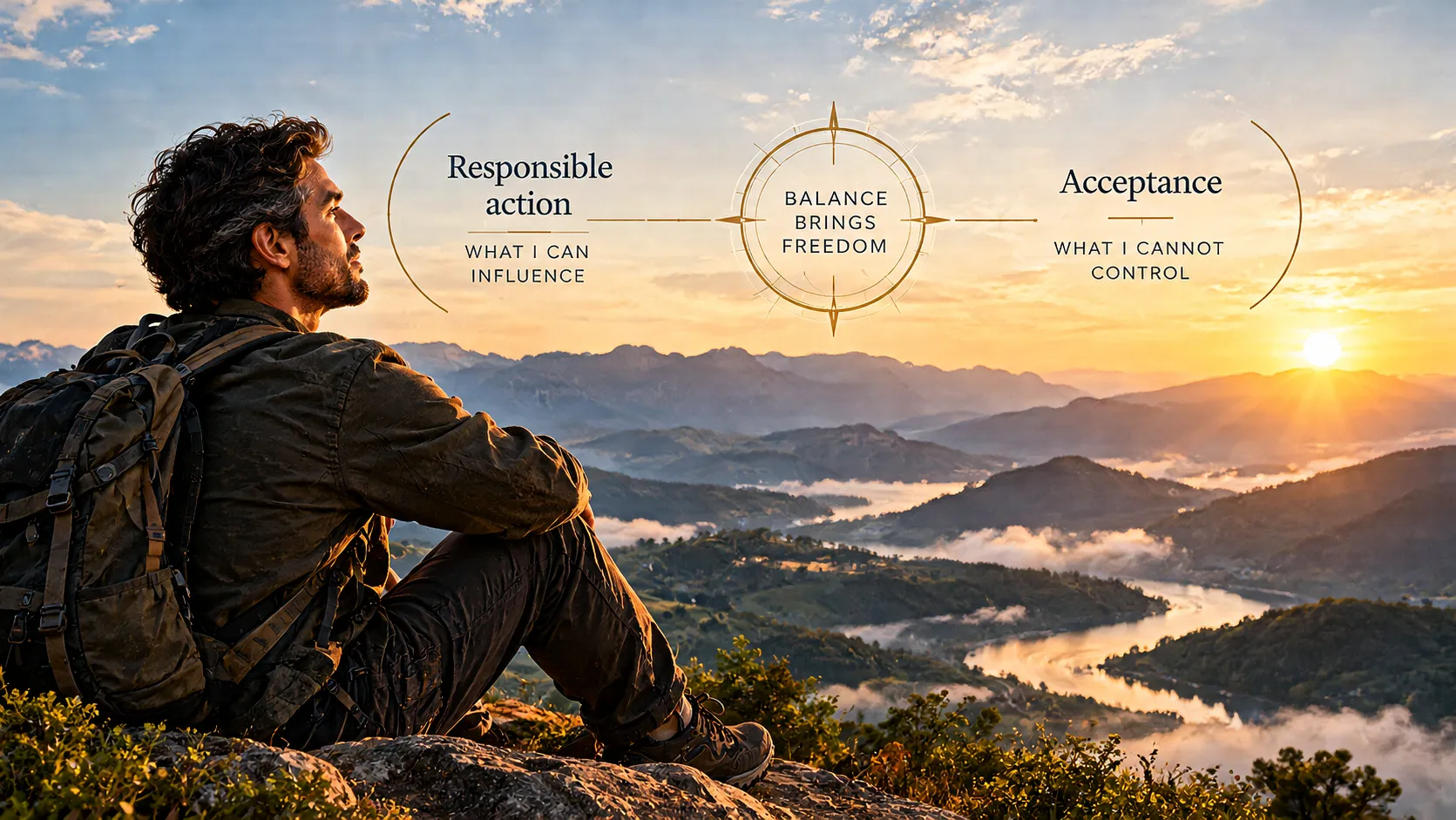
A central Stoic concern is the distinction between what depends on our own judgment and choice and what does not.
Our decisions, intentions, and considered responses belong more directly to our responsibility than external events or the opinions of others.
This does not mean external circumstances are irrelevant.
Health, relationships, material resources, and social conditions can substantially affect our lives.
Rather, Stoicism asks us to consider where ethical responsibility is most directly exercised.
Imagine someone preparing for an important professional opportunity.
They can develop their qualifications, communicate thoughtfully, and approach the situation with integrity.
But they cannot guarantee the final decision.
The outcome may depend on other candidates, organizational priorities, economic conditions, or information unavailable to them.
A Stoic perspective would encourage serious preparation while questioning the assumption that personal worth should depend entirely on the result.
This is more demanding than simply accepting whatever happens.
Classical Stoicism places considerable emphasis on virtue, rational judgment, and the ethical quality of our actions.
It encourages us to examine not only whether we achieve our goals, but also how we pursue them.
Are we acting honestly?
Are we exercising sound judgment?
Are we treating others fairly?
Are we allowing fear or ambition to override what we consider right?
These questions remain relevant in contemporary professional and personal life.
However, Stoicism should not be reduced to emotional suppression or indifference.
Its philosophical approach to emotion involves examining the judgments that shape our responses, not merely pretending that human feelings do not exist.
Engaging with Stoicism can therefore offer an opportunity to reconsider the relationship between responsible action and attachment to outcomes.
We can work seriously toward what matters without assuming that every result is ours to command.
Buddhist Traditions and the Nature of Suffering
Buddhist traditions approach human experience through a different philosophical and spiritual framework.
Originating in ancient India and developing across many cultures, Buddhism encompasses diverse schools, practices, interpretations, and communities.
It cannot be adequately represented by a single modern technique or a simplified message about relaxation.
Nevertheless, certain foundational teachings offer important perspectives on suffering, attachment, and the changing nature of experience.
In Buddhist thought, the concept commonly translated as suffering or unsatisfactoriness, dukkha, points toward the vulnerability and instability that characterize conditioned existence.
Pleasant experiences change.
Unpleasant experiences arise.
Relationships, circumstances, physical conditions, and personal expectations remain subject to impermanence.
Difficulties can emerge when we expect changing experiences to provide permanent satisfaction or security.
Consider the pursuit of professional recognition.
Someone works toward an important achievement, believing that reaching it will finally establish a lasting sense of fulfillment.
When the achievement arrives, they may experience genuine satisfaction.
But eventually, new concerns appear.
There are additional responsibilities, new comparisons, and further goals.
The original achievement was meaningful, but it did not permanently eliminate the conditions that give rise to dissatisfaction.
A Buddhist perspective may invite us to investigate the expectations and attachments surrounding this experience.
What are we seeking through recognition?
How do we relate to success when it arrives?
What happens when we demand permanence from circumstances that inevitably change?
These questions do not require us to reject ambition, material life, or human relationships.
They invite careful examination of how desire and attachment influence experience.
Buddhist traditions also contain sophisticated approaches to attention and mental cultivation.
Practices associated with mindfulness, concentration, and ethical conduct have developed within broader frameworks concerned with wisdom and liberation.
In contemporary settings, mindfulness is often presented as a method of reducing stress or improving concentration.
Such applications may have practical value, but they do not represent the full scope of Buddhist teachings.
Traditional Buddhist practice involves ethical and philosophical dimensions that extend beyond personal comfort or productivity.
Recognizing this distinction allows us to engage with Buddhist wisdom respectfully.
Rather than treating Buddhism as a collection of convenient techniques, we can approach it as a living family of traditions whose teachings deserve study within their own contexts.
Daoist Philosophy and the Art of Living with Change
Daoist philosophy offers another distinctive perspective on the relationship between human intention and the larger patterns of life.
Associated with classical Chinese texts such as the Daodejing and the Zhuangzi, early Daoist thought explores questions involving naturalness, flexibility, knowledge, social conventions, and the limitations of rigid human expectations.
One important concept is wu wei, often translated as non-action or effortless action.
These translations can be misleading when interpreted as doing nothing.
In philosophical Daoist contexts, wu wei can suggest acting without unnecessary forcing, allowing conduct to respond appropriately to the conditions of a situation rather than imposing a rigid will upon them.
Consider someone managing a complex project.
They establish a detailed plan, organize responsibilities, and anticipate possible difficulties.
These activities may be entirely appropriate.
But circumstances begin changing.
New information becomes available. Unexpected limitations arise. The original strategy no longer fits the situation.
The person can continue forcing the initial plan, treating every unexpected development as an obstacle to overcome.
Or they can pay closer attention to the conditions that actually exist and adapt their approach.
The second possibility offers a practical analogy for one aspect of Daoist flexibility.
This does not mean that Daoism is simply a philosophy of efficient management.
Its classical texts explore deeper questions about language, distinctions, human ambition, conventional values, and our place within the wider order of existence.
The Zhuangzi, for example, frequently challenges rigid perspectives through stories, paradoxes, and shifts in viewpoint.
Such approaches encourage humility regarding the completeness of our own understanding.
We may believe that we have correctly interpreted a situation because we are familiar with one particular way of seeing it.
But another perspective may reveal assumptions we had not recognized.
For contemporary readers, Daoist philosophy can encourage a less rigid relationship with plans, expectations, and personal certainty.
We can act deliberately while remaining attentive to changing circumstances.
We can develop capabilities without assuming that every situation should be approached through force.
And we can recognize that flexibility is not necessarily weakness.
Sometimes, responding wisely requires changing direction.
Different Traditions Are Not Different Names for the Same Teaching
When exploring ancient wisdom, it can be tempting to conclude that every spiritual and philosophical tradition ultimately teaches the same thing.
There are understandable reasons for this impression.
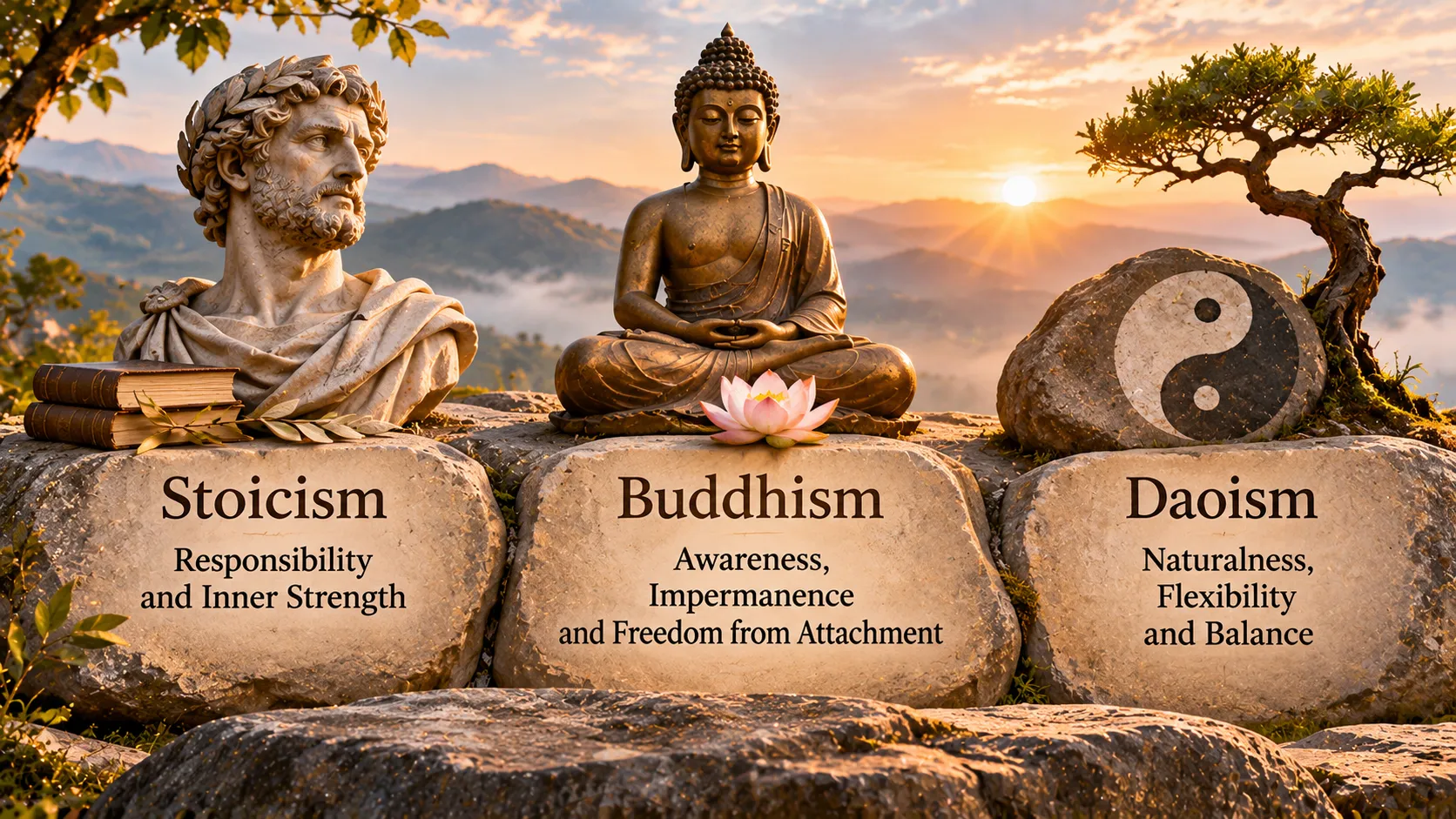
Stoicism, Buddhism, and Daoist philosophy each examine aspects of human judgment, desire, conduct, and our relationship with circumstances.
Certain practices or insights may appear similar when described in broad terms.
But similarities should not erase meaningful differences.
Stoicism developed within a philosophical framework involving reason, virtue, and an ordered cosmos.
Buddhist traditions explore suffering, impermanence, non-self, karma, and liberation through distinctive philosophical and religious teachings.
Daoist philosophy addresses the Dao, naturalness, spontaneity, and the limitations of conventional distinctions in ways that do not simply reproduce Stoic or Buddhist arguments.
Their historical contexts, metaphysical assumptions, ethical systems, and ultimate aims are not interchangeable.
Even within each tradition, there are substantial differences among schools and interpretations.
Respectful engagement requires allowing these differences to remain visible.
We do not need to claim that all traditions lead to an identical destination in order to learn from more than one of them.
In fact, their differences may be among their most valuable contributions.
A perspective that challenges our assumptions can teach us something precisely because it does not fit neatly within what we already believe.
Ancient Wisdom Is Not an Escape from Modern Responsibility
There is another distinction worth preserving.
Philosophical reflection does not replace practical action.
Someone facing financial hardship may benefit from examining their relationship with uncertainty, but philosophical acceptance does not eliminate the need for income, planning, or material support.
A person experiencing a difficult relationship may gain insight from teachings about attachment, but insight does not remove the importance of communication, boundaries, safety, and mutual responsibility.
Someone struggling with emotional distress may find contemplative practices meaningful, while still needing appropriate professional assistance.
Ancient wisdom becomes most useful when it contributes to a more complete engagement with life rather than serving as an explanation for avoiding its difficulties.
We can investigate our desires while continuing to pursue meaningful goals.
We can develop acceptance while working to improve difficult circumstances.
We can practice attention without withdrawing from the responsibilities of work, family, and community.
And we can question our assumptions while remaining committed to evidence, practical reasoning, and the well-being of others.
A thoughtful relationship with ancient traditions does not require choosing between reflection and action.
It allows each to inform the other.
Learning Without Needing to Believe Everything
Approaching ancient wisdom does not require immediate agreement.
A person can study Stoic philosophy without adopting every aspect of Stoic cosmology.
They can explore Buddhist perspectives on attachment and impermanence without identifying as Buddhist.
They can reflect on classical Daoist texts without claiming to understand or accept every dimension of Daoist philosophy.
There is value in approaching these traditions as serious bodies of thought rather than as collections of inspirational sayings.
Their ideas can be examined, questioned, compared, and considered in relation to our own experience.
Some may offer practical insight.
Others may remain difficult to understand or incompatible with our beliefs.
That is not necessarily a problem.
The purpose of philosophical inquiry is not always to arrive at immediate agreement.
Sometimes, it is to become aware of questions we had not previously considered.
We might discover that our definition of success is narrower than we assumed.
We might recognize that our relationship with uncertainty is shaped by unrealistic expectations.
We might begin questioning whether constant activity is equivalent to meaningful progress.
Or we might find that an ancient perspective encourages us to appreciate something in modern life that we had taken for granted.
Wisdom does not necessarily emerge from accepting an answer.
It may begin with learning to ask a better question.
Bringing Ancient Insights into Everyday Life
The relevance of ancient wisdom becomes clearer when reflection influences ordinary decisions.
Before reacting to criticism, we might consider whether our judgment has been shaped by assumptions that deserve examination.
While pursuing an important goal, we might distinguish meaningful effort from the expectation that success will provide permanent fulfillment.
When circumstances change unexpectedly, we might ask whether our resistance reflects a genuine problem or an attachment to a particular plan.
These are not complete representations of Stoicism, Buddhism, or Daoism.
They are examples of how studying different philosophical perspectives can inform contemporary reflection.
The intention is not to transform every daily experience into a philosophical exercise.
Nor is it to assemble fragments of different traditions into a new doctrine.
It is to develop the habit of considering our experience from more than one perspective.
This can help us respond with greater discernment.
It may also encourage intellectual humility.
The fact that a question has been explored for centuries does not mean its answer is simple.
And the fact that we have developed a familiar explanation does not mean we have exhausted everything worth understanding.
A Continuing Conversation Across Time
Ancient wisdom remains relevant not because the world has stopped changing, but because human beings continue facing questions that cannot be resolved through technology or information alone.
We still encounter uncertainty.
We still experience desire, disappointment, ambition, and loss.
We continue searching for meaning, developing relationships, and deciding how to participate in the world around us.
The philosophers and contemplative practitioners of earlier centuries lived under conditions very different from our own.
Their teachings emerged from particular communities, languages, institutions, and historical experiences.
We should not ignore those differences.
But neither must we assume that temporal distance makes their questions irrelevant.
Across centuries, human beings have continued investigating what it means to live well.
We can enter that conversation without surrendering our independence of thought.
We can study carefully, recognize differences, question what we encounter, and remain open to insights that improve our understanding.
The purpose is not to escape the present by idealizing the past.
It is to bring greater depth to the way we inhabit the present.
Ancient traditions cannot make our choices for us.
They cannot guarantee happiness, eliminate uncertainty, or provide a single answer to every human difficulty.
But they can remind us that the questions we face belong to a much larger history of human reflection.
And sometimes, discovering how others have approached those questions helps us see our own lives with greater clarity.
Wisdom does not belong exclusively to the past or the present. It develops wherever human beings are willing to examine life with attention, humility, and discernment.