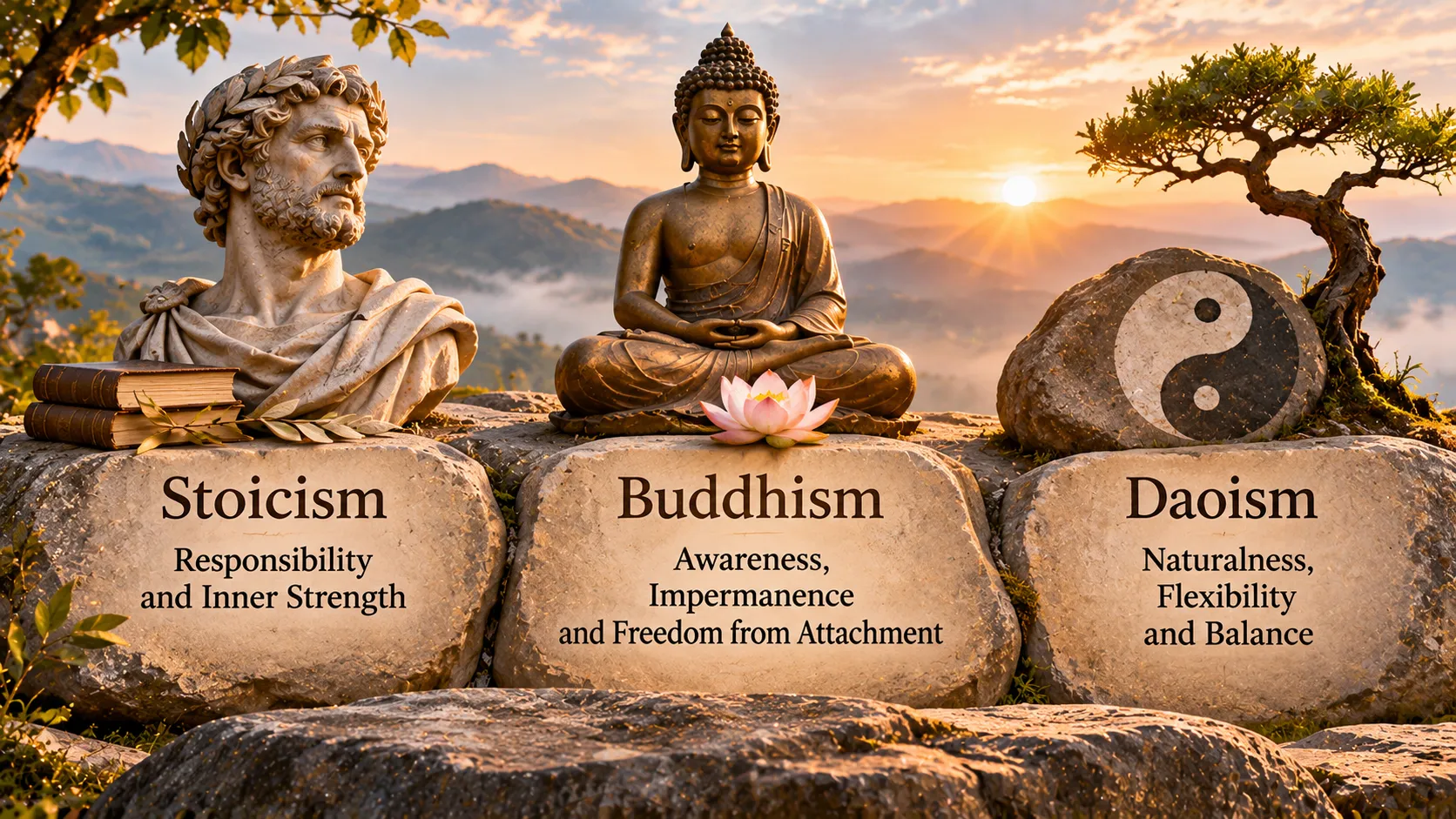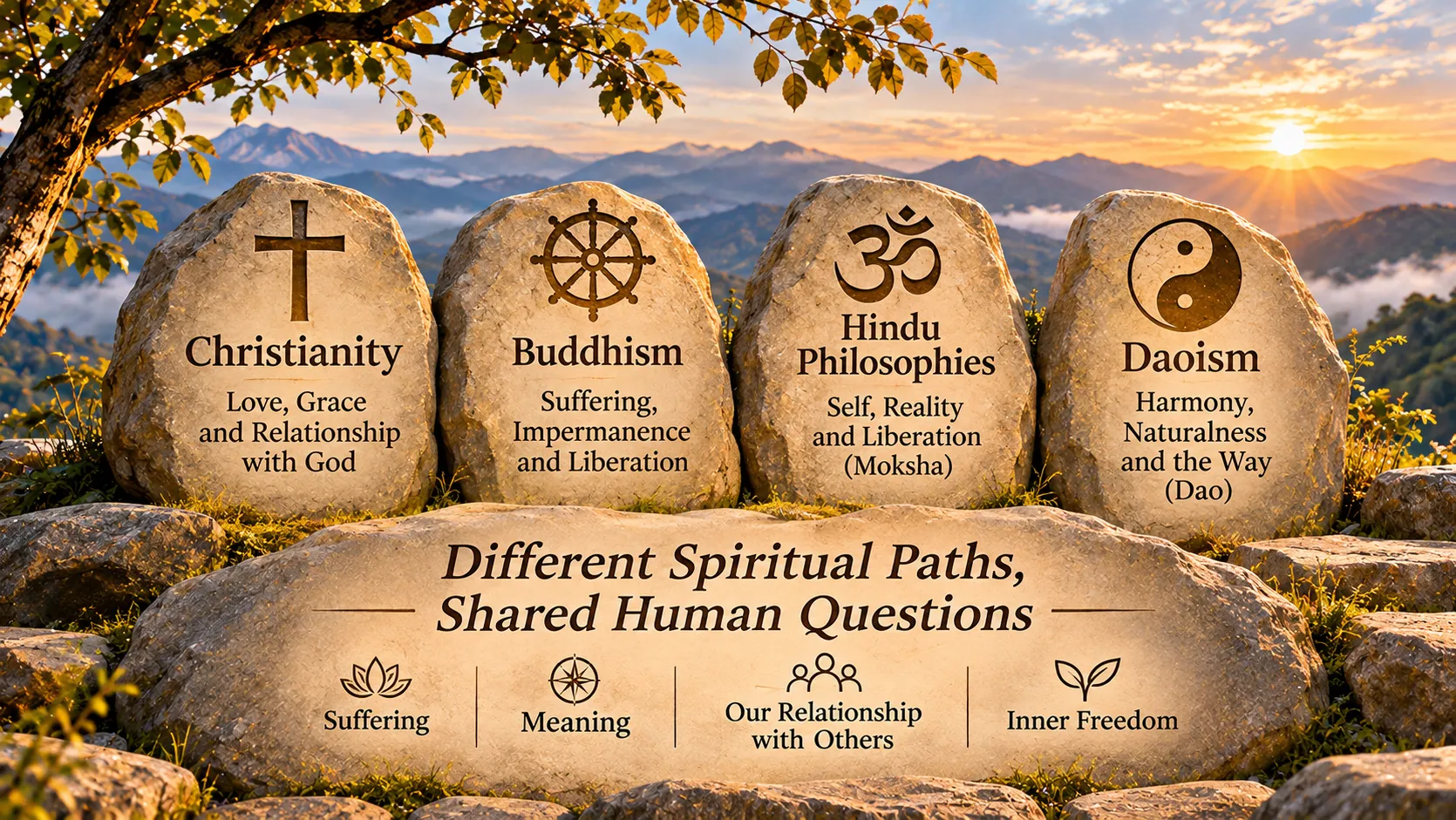
Across different cultures and centuries, human beings have developed remarkably diverse ways of understanding existence.
Some traditions describe reality through the relationship between humanity and a personal God. Others explore consciousness, suffering, liberation, or the natural order without placing a creator deity at the center of their teachings.
Some emphasize prayer, devotion, and religious community. Others cultivate meditation, philosophical inquiry, ethical discipline, or contemplation.
Their languages, symbols, practices, and understandings of reality can differ profoundly.
Yet beneath these differences, we sometimes encounter questions that seem familiar.
Why do human beings suffer?
What gives life meaning?
How should we treat one another?
Is it possible to become less governed by fear, attachment, or habitual reactions?
What does it mean to live well in a world we cannot fully understand or control?
These questions do not belong exclusively to any one culture or religious tradition.
They emerge from experiences that human beings encounter in many different circumstances: love, loss, uncertainty, responsibility, desire, mortality, and the search for belonging.
Recognizing these shared concerns can create opportunities for meaningful dialogue.
But there is an important distinction.
Asking similar questions does not mean arriving at the same answers.
Understanding this difference may be one of the most valuable starting points for exploring spiritual wisdom with both openness and respect.
The Human Experience Behind Spiritual Inquiry
Spiritual traditions do not emerge in isolation from human life.
They develop within communities, languages, historical circumstances, cultural practices, and ways of interpreting experience.
Their teachings may address ultimate questions about reality, but they also engage with practical concerns.
How should people behave toward one another?
How can individuals respond to loss?
What responsibilities do we have toward our families and communities?
How should we understand our desires, limitations, and obligations?
These concerns are not exclusively religious.
A person who identifies with no spiritual tradition may still reflect deeply on the meaning of existence, the nature of suffering, and the responsibilities that accompany human freedom.
Likewise, someone who belongs to a religious community may approach these questions through teachings, rituals, and commitments that are inseparable from their faith.
The common ground is not necessarily a shared worldview.
It is the human capacity to ask questions about life that extend beyond immediate practical needs.
Consider the experience of losing someone important.
The emotional reality of grief can be recognized across cultures.
But different traditions may interpret death, continuity, memory, and the meaning of loss in very different ways.
One person may understand grief through faith in God and the hope of resurrection.
Another may consider it through Buddhist teachings about impermanence and attachment.
Someone else may approach it through philosophical reflection, family traditions, or a nonreligious understanding of mortality.
The experience may invite similar questions.
The answers remain distinct.
Respectful dialogue begins when we can recognize both realities without forcing them into agreement.
Christianity: Love, Grace, and Relationship with God
Christianity is a diverse religious tradition centered on the life, teachings, death, and resurrection of Jesus Christ.
Its theological expressions differ across Catholic, Orthodox, Protestant, and other Christian communities.
Yet Christian understandings of the human condition commonly involve questions about the relationship between humanity and God, the reality of sin, the possibility of reconciliation, and the meaning of love and redemption.
Within Christian teaching, love is not merely an emotional experience.
It is closely connected to ethical responsibility, compassion, forgiveness, and care for others.
The commandment to love one’s neighbor has shaped Christian approaches to personal conduct, community, charity, and social responsibility.
Christian traditions also place significant importance on grace.
In many Christian theological understandings, humanity’s relationship with God cannot be reduced to personal effort, intellectual achievement, or self-improvement.
This creates a distinctive perspective on transformation.
While practices such as prayer, moral discipline, contemplation, and service are important, Christian spiritual life is not simply a method of becoming more psychologically aware.
It involves a relationship with God understood through particular theological commitments.
This distinction matters.
A reader may find practical value in Christian reflections on forgiveness or compassion without adopting Christian beliefs.
But those reflections should not be presented as though they existed independently of the religious framework in which they developed.
For many Christians, the meaning of love, freedom, and transformation is inseparable from their understanding of Christ.
Respecting that context allows dialogue without reducing Christianity to a collection of general principles about personal growth.
Buddhism: Suffering, Impermanence, and Liberation
Buddhist traditions begin from a different understanding of the human condition.
Originating in ancient India and developing across Asia and beyond, Buddhism includes multiple schools with distinct philosophical teachings and practices.
Despite this diversity, the Four Noble Truths remain foundational across major Buddhist traditions.
They examine suffering or unsatisfactoriness, its arising, its cessation, and the path associated with liberation.
The term dukkha, often translated as suffering, has a broader meaning than ordinary physical or emotional pain.
It also points toward the instability and unsatisfactory character of conditioned experience.
Pleasant circumstances change.
Relationships evolve.
Bodies age.
Expectations are not always fulfilled.
Even experiences we deeply appreciate cannot be preserved permanently in exactly the same form.
Buddhist teachings invite investigation into the ways craving, ignorance, and attachment contribute to suffering.
They also describe paths of ethical conduct, meditation, and wisdom intended to address these conditions.
Consider someone whose sense of personal worth depends entirely on recognition.
When praised, they feel secure.
When criticized, they feel threatened.
When overlooked, they experience disappointment.
A Buddhist perspective may encourage examination of the attachment involved in this changing emotional experience.
Yet Buddhist liberation should not be equated with the contemporary goal of feeling calm or confident.
Its traditional meaning involves a much broader philosophical and spiritual framework, including teachings about karma, rebirth, and the nature of self, interpreted differently across Buddhist schools.
Here we encounter a significant difference from Christianity.
Christian teachings generally understand spiritual life through a relationship with God, while Buddhist traditions do not center liberation on reconciliation with a creator deity.
Both may address suffering and compassion.
But their explanations of the human condition and their ultimate religious aims are not identical.
Their distinctiveness deserves recognition.
Hindu Philosophical Traditions: Self, Reality, and Liberation
The philosophical and religious traditions commonly grouped under the term Hinduism encompass an extraordinary range of teachings, practices, and understandings of reality.
There is no single philosophical position that adequately represents them all.
Different Hindu schools have developed sophisticated approaches to questions involving the self, consciousness, action, knowledge, devotion, and liberation.
One important concept is moksha, often understood as liberation from the cycle of rebirth.
Its interpretation varies significantly among traditions.
Some schools emphasize knowledge and philosophical discernment.
Others emphasize devotion to a personal deity, disciplined action, meditation, or combinations of different approaches.
Within Advaita Vedanta, for example, liberation is closely associated with knowledge of the ultimate identity of Atman and Brahman.
This is a specific philosophical position, not a teaching shared by every Hindu tradition.
Other schools, including several theistic traditions, maintain distinctions between the individual self and the divine.
These differences are substantial.
They influence how spiritual practice, personal identity, and liberation are understood.
The Bhagavad Gita, a foundational text for many Hindu traditions, explores questions involving duty, action, knowledge, devotion, and the difficulties of making decisions within complex moral circumstances.
Its setting is a dialogue between Krishna and Arjuna before a battle, where Arjuna confronts profound uncertainty about his responsibilities.
The text has received varied interpretations across centuries.
But its concern with action and responsibility remains particularly interesting for modern philosophical reflection.
How do we act when competing responsibilities create uncertainty?
Can we fulfill our duties without becoming entirely attached to personal rewards?
How should knowledge, commitment, and ethical discernment influence action?
These questions can resonate beyond the religious communities in which the text is studied.
Yet the Bhagavad Gita should not be reduced to a modern guide to productivity or emotional resilience.
Its teachings emerge from theological, philosophical, and cultural contexts that deserve careful consideration.
Engaging respectfully with Hindu philosophy means recognizing both its relevance to enduring human questions and the diversity of its answers.
Daoism: Harmony, Naturalness, and the Limits of Force
Daoist thought introduces another distinctive way of exploring human life.
Classical philosophical texts such as the Daodejing and the Zhuangzi investigate the relationship between human conduct, language, conventional distinctions, and the Dao.
Dao is often translated as the Way, although no simple English expression captures its full range of meanings.
In classical Daoist philosophy, the Dao is not simply equivalent to the personal God of Christian theology or the ultimate reality described by every Hindu school.
Daoist approaches should be understood within their own historical and philosophical contexts.
One recurring theme involves questioning the tendency to impose rigid expectations upon the changing conditions of existence.
The concept of wu wei, often rendered as non-action or effortless action, can suggest conduct that avoids unnecessary forcing and responds appropriately to circumstances.
Imagine someone who believes that every successful outcome must emerge from strict personal control.
They organize every detail, resist unexpected changes, and become increasingly frustrated when events fail to follow their plans.
A Daoist perspective may invite reflection on whether some difficulties are intensified by excessive interference or rigidity.
Can action become more responsive?
Can flexibility be an expression of wisdom rather than weakness?
Can we participate effectively without assuming that everything must conform to our preferred design?
These questions offer useful possibilities for contemporary reflection.
But Daoism is not merely a philosophy of stress reduction or relaxed productivity.
Its texts explore deeper questions involving naturalness, knowledge, spontaneity, political life, and the relationship between human conventions and the wider patterns of existence.
Daoist religious traditions also include diverse forms of ritual, cultivation, cosmology, and community practice that extend beyond the classical philosophical texts.
Respecting these dimensions prevents us from turning Daoism into a collection of convenient metaphors.
Shared Questions Do Not Erase Different Answers
After examining different traditions, it may be tempting to identify a universal teaching that supposedly exists behind them all.
Perhaps we notice that Christianity emphasizes love, Buddhism cultivates compassion, Hindu traditions explore liberation, and Daoism encourages harmony.
We might conclude that these are simply different expressions of one underlying spiritual truth.
But such a conclusion can overlook essential differences.
Love within Christian theology is not necessarily equivalent to compassion within Buddhist ethics.
Liberation in Advaita Vedanta is not identical to nirvana in Buddhist traditions.
The Dao is not simply another name for Brahman or the Christian God.
Even concepts that appear similar in translation may carry distinct meanings within their respective systems.
These traditions also disagree about significant questions.
Is there a permanent self?
What is the ultimate nature of reality?
Does liberation involve a relationship with a personal deity?
What happens after death?
What is the final aim of spiritual practice?
Different traditions offer answers that cannot always be reconciled.
Acknowledging these disagreements does not prevent respectful appreciation.
In fact, it makes appreciation more meaningful.
When we allow a tradition to express its own understanding of reality, we encounter something more substantial than a reflection of our existing beliefs.
We become capable of learning from differences rather than simply collecting similarities.
The Possibility of Dialogue Without Agreement
Meaningful dialogue does not require everyone to reach the same conclusion.
Two people can approach an important question from different philosophical or religious perspectives and still benefit from the exchange.
Consider a conversation about forgiveness.
A Christian participant may understand forgiveness through teachings concerning divine grace, reconciliation, and the example of Christ.
A Buddhist participant may explore the relationship between resentment, suffering, compassion, and the cultivation of mental states.
A nonreligious participant may approach forgiveness through ethical reasoning, emotional well-being, and the practical conditions required for rebuilding trust.
These perspectives are not interchangeable.
They may differ about what forgiveness means, why it matters, and whether reconciliation is necessary or appropriate.
Nevertheless, the conversation can reveal important questions.
What responsibilities do we have after being harmed?
Does forgiveness require the restoration of a relationship?
How do we distinguish compassion from tolerating further mistreatment?
What forms of accountability are necessary?
The value of dialogue does not depend on eliminating disagreements.
It can emerge from listening carefully, identifying assumptions, and understanding why other people interpret the same human concern differently.
Such conversations require humility.
We must be willing to acknowledge that our understanding of another tradition may be incomplete.
We must avoid assuming that unfamiliar beliefs are simply confused versions of our own.
And we must recognize that people within the same religious community may interpret their traditions differently.
Dialogue becomes more responsible when curiosity is accompanied by respect for complexity.
Spiritual Exploration Without Appropriation
Contemporary readers can encounter teachings from many cultures with unprecedented ease.
Sacred texts, philosophical discussions, meditation practices, and religious commentaries are available through books, courses, digital libraries, and online communities.
This accessibility creates valuable opportunities for learning.
It also creates responsibilities.
A teaching cannot always be understood accurately when separated from the tradition that developed it.
A meditation practice may belong to a broader ethical and religious framework.
A sacred symbol may have meanings that extend beyond its visual beauty.
A philosophical concept may depend on distinctions that are difficult to preserve through simplified translation.
Responsible exploration involves asking where an idea comes from, how it has been interpreted, and whether its use respects the communities that preserve it.
It also involves distinguishing between studying a tradition and claiming authority within it.
Someone may appreciate Buddhist teachings without presenting themselves as a Buddhist teacher.
A reader may explore Hindu philosophy without treating its sacred concepts as interchangeable with personal metaphysical preferences.
A person can learn about Christian mysticism while recognizing that it developed within particular theological and ecclesial contexts.
Respect does not require avoiding traditions that are different from our own.
It requires approaching them with sufficient care to recognize that they are more than resources for personal consumption.
What Different Traditions Can Teach Us About Humility
One of the most valuable outcomes of comparative spiritual inquiry may be a greater awareness of the limits of our own perspective.
We often inherit assumptions about reality without recognizing that they are assumptions.
Our family, culture, education, experiences, and social environment influence what seems obvious or reasonable.
Encountering a different philosophical tradition can make those assumptions visible.
A person accustomed to evaluating life primarily through achievement may discover a tradition that places greater emphasis on detachment from results.
Someone who understands identity as a stable and enduring personal essence may encounter philosophical arguments questioning that assumption.
A reader who views spirituality primarily as a private experience may discover traditions in which ritual, community, ethical obligations, and shared religious life are central.
These encounters do not require immediate agreement.
Their value may lie in revealing that familiar interpretations are not the only interpretations human beings have developed.
This can encourage a more careful form of reflection.
Instead of asking only whether another tradition confirms what we already believe, we can ask what it helps us understand about the assumptions we bring to the conversation.
We may discover insights worth considering.
We may also develop a clearer appreciation of our own commitments.
Both outcomes can be meaningful.
Living with Questions That Remain Open
Some human questions resist simple answers.
Why does suffering exist?
What is the relationship between consciousness and reality?
What gives human life its deepest meaning?
How should we understand freedom, responsibility, and the possibility of transformation?
Religious and philosophical traditions have developed substantial answers to these questions.
For their adherents, those answers may carry profound authority and shape entire ways of living.
Other people may approach the same questions with uncertainty, skepticism, or an openness to continued investigation.
There is room for thoughtful inquiry across these different positions.
Exploring spiritual wisdom does not require treating every perspective as equally convincing.
Nor does it require avoiding difficult disagreements.
We can evaluate arguments, examine evidence, study historical contexts, and consider the consequences of different beliefs.
We can remain committed to a particular tradition while seeking to understand others.
We can also investigate spiritual questions without adopting a religious identity.
What matters is the quality of the engagement.
Are we listening carefully?
Are we representing other perspectives accurately?
Are we willing to recognize what we do not know?
Can we learn without needing to possess every answer?
These questions are themselves expressions of intellectual and spiritual humility.
Many Paths, a Shared Human World
The diversity of spiritual traditions reflects the richness and complexity of humanity’s attempts to understand existence.
Different communities have developed teachings about suffering, responsibility, love, liberation, harmony, and the meaning of life.
Some of their questions overlap.
Many of their answers differ.
These differences need not become barriers to respectful exploration.
They can remind us that human understanding develops within distinct histories, languages, and relationships with the world.
We do not need to declare that every tradition teaches the same truth to recognize the seriousness of its inquiry.
We do not need to adopt another person’s beliefs to treat those beliefs with respect.
And we do not need to abandon our own convictions to remain curious about how others understand the human experience.
Perhaps the most meaningful point of connection is not the idea that all spiritual paths lead to the same destination.
Perhaps it is the recognition that people across cultures continue asking questions that arise from the conditions of being human.
We experience love and loss.
We confront uncertainty.
We seek meaning.
We make choices that affect others.
We encounter the limits of our understanding.
And we continue searching for ways to live with wisdom, responsibility, and compassion.
Our answers may remain different.
But the possibility of thoughtful dialogue remains open.
We do not have to believe the same things to recognize the depth of one another’s questions—or to share the responsibility of living together in the same world.