There is a certain comfort in believing that life can be managed if we make the right decisions.
We plan our days, organize our responsibilities, prepare for difficulties, and try to anticipate what might happen next. We build routines, establish goals, and make choices intended to create stability.
Much of this is necessary.
Planning helps us use our resources wisely. Preparation reduces avoidable risks. Responsibility allows us to fulfill commitments and build relationships based on trust.
But sometimes, the reasonable desire to prepare becomes something more demanding.
We begin to feel that we must anticipate every problem, prevent every disappointment, and ensure that events unfold according to our expectations.
We try to control not only our actions, but also the reactions of others, the timing of opportunities, and the consequences of decisions we have not yet made.
What began as an attempt to create security can gradually become a source of tension.
The challenge is not to stop caring about outcomes.
It is to recognize the difference between influencing what happens and expecting to control everything that happens.
Why We Want Certainty
Human beings naturally seek patterns, stability, and predictability.
Knowing what to expect helps us make decisions, manage risks, and navigate everyday responsibilities.
When life becomes uncertain, we often respond by searching for more information, making additional plans, or trying to eliminate possible sources of difficulty.
These responses can be useful.
Someone preparing for a new job may research the organization, develop relevant skills, and plan how to approach unfamiliar responsibilities.
A family facing financial uncertainty may review expenses, establish priorities, and explore additional sources of income.
A person entering an important conversation may consider what they want to communicate and how to express it clearly.
In each case, preparation creates possibilities for more informed action.
The difficulty begins when preparation becomes an attempt to eliminate uncertainty altogether.
We may believe that if we think about a situation long enough, we can discover a way to guarantee the result.
We imagine that every risk must have a solution and every future difficulty must be anticipated.
Yet life rarely offers complete information.
Circumstances change. People make independent decisions. Unexpected events influence even carefully designed plans.
The desire for certainty is understandable, but certainty is not always available.
Recognizing this limitation does not mean abandoning preparation.
It means learning to prepare without demanding guarantees that preparation cannot provide.
The Difference Between Responsibility and Control
Responsibility concerns how we participate in a situation.
Control concerns how much influence we can exercise over its outcome.
These two things are related, but they are not identical.
Consider someone applying for an important professional opportunity.
They can prepare a thoughtful application, develop their qualifications, research the organization, and communicate their experience clearly.
These actions are within their sphere of responsibility.
But they cannot determine how every interviewer will interpret their answers, how other candidates will perform, or whether the organization will change its priorities.
The outcome depends on multiple factors.
A responsible person can make a serious effort without possessing complete control over the result.
This distinction becomes particularly important when things do not go as planned.
If we believe that every outcome depends entirely on our actions, disappointment can easily become self-accusation.
We may assume that failure proves we did not work hard enough, think positively enough, or prepare carefully enough.
Sometimes, a disappointing result does reveal a mistake that deserves attention.
At other times, the result reflects circumstances beyond our influence.
Maturity involves being willing to examine both possibilities.
We can take responsibility for what we did without claiming responsibility for everything that happened.
When Control Enters Our Relationships
The desire to control outcomes becomes especially complicated in relationships.
We may genuinely care about another person’s well-being while struggling to accept that they have their own preferences, interpretations, and decisions.
A parent may want to protect an adult child from making mistakes.
A partner may want reassurance that a relationship will never change.
A friend may become frustrated when carefully offered advice is not followed.
These reactions often emerge from understandable concerns.
We want people we love to be safe. We want relationships to remain meaningful. We want our intentions to be understood.
But concern does not automatically give us authority over another person’s choices.
Imagine someone preparing for a difficult conversation with their partner.
They carefully organize their thoughts, choose their words, and imagine how the discussion should unfold.
They expect that if they explain themselves clearly enough, the other person will finally understand and agree.
But the conversation develops differently.
Their partner interprets the situation in another way, expresses unfamiliar concerns, or needs more time to consider what has been said.
The person may experience this as a failure of communication.
Yet disagreement does not necessarily mean communication has failed.
Two people can understand each other and still want different things.
A healthy relationship requires the ability to express needs, establish boundaries, negotiate responsibilities, and acknowledge differences.
It does not require one person to manage the other’s internal experience.
We can communicate honestly without guaranteeing agreement.
We can offer support without controlling another person’s decisions.
We can establish boundaries without demanding that everyone approve of them.
Letting go of excessive control in relationships does not mean tolerating disrespect or abandoning our own needs.
It means recognizing the other person’s freedom while remaining responsible for our participation in the relationship.
The Exhaustion of Managing Every Possible Outcome
Excessive control can become mentally demanding because it expands the number of things we believe require our attention.
Instead of responding to what is happening, we begin living through imagined versions of what might happen.
We rehearse conversations that have not occurred.
We anticipate criticism that may never arrive.
We attempt to solve problems that depend on information we do not yet possess.
We revisit decisions repeatedly, searching for assurance that no better alternative exists.
Some anticipation is useful. Considering risks can improve decisions.
But when the search for certainty becomes endless, preparation may turn into a form of avoidance.
Someone may spend weeks researching a project without taking the first practical step because they are still trying to identify the perfect approach.
Another person may delay an important conversation until they feel certain they can prevent an uncomfortable response.
A professional may continue revising completed work because they cannot tolerate the possibility that someone will find a flaw.
In these situations, the desire to control outcomes can interfere with the very actions that might move life forward.
The person is not necessarily lacking motivation.
They may be trying to protect themselves from uncertainty, embarrassment, rejection, or regret.
Recognizing this can open a different question.
Instead of asking, “How can I guarantee that nothing goes wrong?” we might ask, “What preparation is reasonable, and what uncertainty must I accept in order to proceed?”
The second question does not eliminate risk.
It helps us distinguish useful preparation from an endless demand for reassurance.
Planning Without Becoming Attached to the Plan
A plan is a valuable instrument.
It helps organize attention, coordinate resources, and translate intentions into practical action.
But a plan is not a contract with the future.
It is a framework developed using the information available at a particular moment.
As new information emerges, the framework may need to change.
Consider someone building a small business.
They research their audience, estimate expenses, develop a product, and establish a realistic schedule.
Their planning is essential.
But once the product reaches the market, they may discover that customers respond differently than expected.
Perhaps demand is lower than anticipated. Perhaps buyers value a feature the creator considered secondary. Perhaps an unexpected opportunity appears.
The person can interpret these developments as evidence that the original plan has failed.
Or they can recognize that planning and adaptation are parts of the same process.
A thoughtful plan provides direction.
Flexibility allows us to respond to reality.
Neither replaces the other.
Without planning, we may act without sufficient consideration.
Without flexibility, we may remain attached to decisions that no longer fit the circumstances.
Letting go of the need for complete control means allowing plans to serve experience rather than requiring experience to obey the plans.
Acceptance Is Not Passivity
The idea of letting go is sometimes misunderstood as surrendering personal agency.
We may imagine that accepting uncertainty means becoming indifferent to results, abandoning ambition, or waiting for life to resolve difficulties on our behalf.
But acceptance and passivity are different.
Acceptance begins with recognizing the conditions that actually exist.
Passivity involves declining to act when meaningful action may be possible.
Someone experiencing financial difficulty can acknowledge the seriousness of the situation while actively seeking solutions.
A person facing conflict can accept that another individual has different opinions while still communicating boundaries and making necessary decisions.
Someone dealing with an unexpected professional setback can recognize that the event has occurred without concluding that nothing can be done next.
Acceptance does not require approval.
We can accept that a circumstance exists while working to change it.
We can acknowledge that a relationship has ended while allowing ourselves to grieve and eventually reconsider what we want from future relationships.
We can recognize a limitation without turning it into a permanent identity.
There is also no reason to assume that releasing control will automatically attract favorable circumstances.
Life does not guarantee rewards in exchange for emotional detachment.
Letting go is valuable for a more practical reason.
It can help us direct our attention toward actions that remain available instead of exhausting ourselves trying to command what lies beyond our influence.
Learning to Act Without Guarantees
Many meaningful decisions must be made before we know how they will unfold.
We cannot fully predict what will happen when we begin a new career, enter a relationship, move to another city, or commit to a creative project.
We can gather information and reduce unnecessary risks.
We can seek advice from experienced people.
We can consider possible consequences and develop alternatives.
But eventually, a decision may require us to act without complete certainty.
This is not necessarily recklessness.
It is part of participating in a world where knowledge is limited and circumstances continue to change.
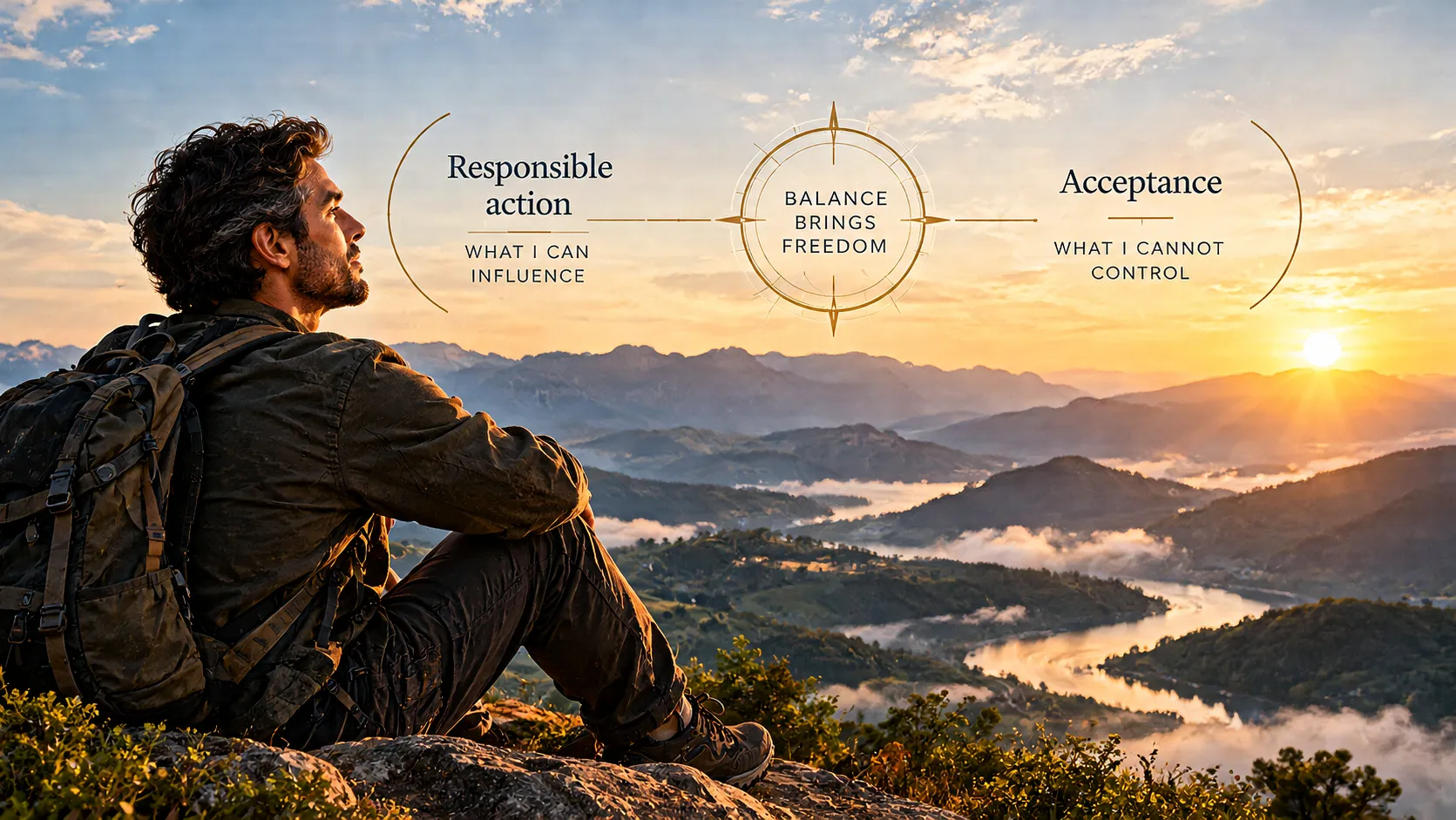
A useful approach is to distinguish three aspects of a situation.
First, what can we directly decide or do?
Second, what can we influence through communication, preparation, or cooperation?
Third, what remains outside our control?
These distinctions are not always perfectly clear. Our influence can change, and sometimes we discover new possibilities through action.
Nevertheless, asking these questions can prevent us from assuming responsibility for outcomes that no individual can fully determine.
We may discover that an important next step is available even though the final result remains uncertain.
That is often enough to begin.
Freedom Within Uncertainty
There is a particular kind of freedom that emerges when we no longer require life to follow a predetermined script.
It is not the freedom of controlling every event.
It is the freedom of developing our capacity to respond.
We can make a careful decision and remain willing to reconsider it.
We can commit to a relationship without expecting to control another person.
We can pursue ambitious goals while acknowledging that results depend on more than determination.
We can take responsibility for mistakes without turning every disappointment into a judgment about our worth.
This approach does not eliminate anxiety, uncertainty, or the desire for security.
Those experiences remain part of being human.
But it allows us to relate to them differently.
Instead of viewing uncertainty as proof that we have failed to prepare adequately, we can recognize it as a condition that accompanies many meaningful choices.
Instead of treating every unexpected event as a threat to our plans, we can examine what the new situation requires.
And instead of measuring our lives exclusively through outcomes, we can also consider the quality of our participation.
Did we act thoughtfully?
Did we use the information available?
Did we respect our responsibilities and the freedom of others?
Are we willing to learn from what happened?
These questions do not guarantee success.
They offer a more realistic foundation for conscious action.
Letting Life Remain Open
The desire to control everything often begins with a reasonable wish: to protect what matters.
We want stability, meaningful relationships, productive work, and a future in which our efforts contribute to something valuable.
There is nothing inherently wrong with these desires.
The challenge is to pursue them without demanding that every circumstance conform to our expectations.
We can build structures without believing they will never need to change.
We can make commitments without assuming that uncertainty will disappear.
We can prepare for the future while remaining attentive to the present.
And we can accept that other people, unexpected events, and changing conditions will continue to influence our experience.
Letting go of excessive control is not a decision to care less about life.
It is an invitation to participate in life without believing we must govern every aspect of it.
We remain responsible for our choices.
We remain capable of learning, planning, creating, and responding.
But we no longer need to confuse responsibility with unlimited power over outcomes.
Perhaps a more conscious way of living begins when we stop asking life to provide absolute certainty before we are willing to act.
We can prepare carefully.
We can choose deliberately.
We can respond to what changes.
And we can allow the future to remain open.
Freedom is not the ability to control everything that happens. It is the growing capacity to act responsibly without requiring guarantees from life.